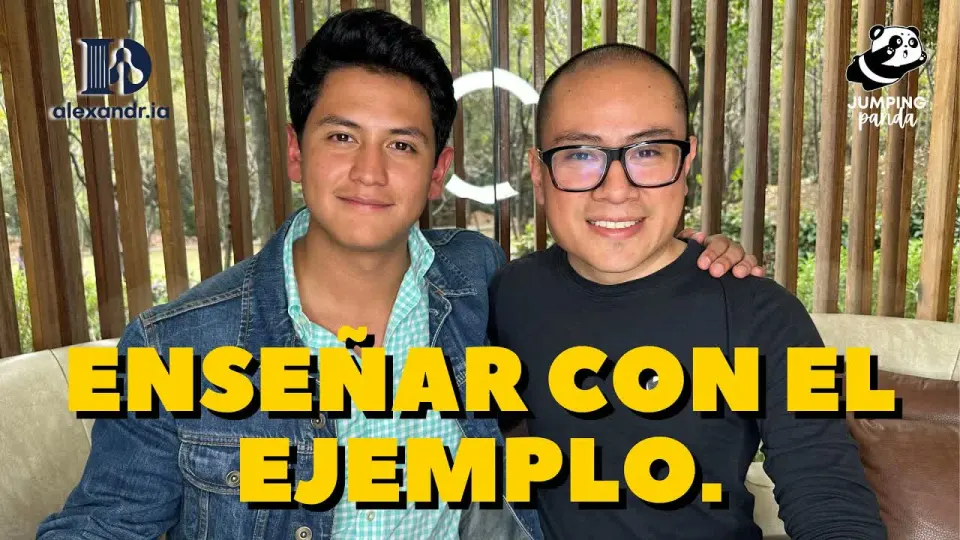

Omar studied computer science and started out working in finance. At 24 or 25 he had a family business that collapsed and left him with serious financial and legal problems. He later sold everything to go to Spain for a master's degree, and came back to Mexico at 40 without a job. Today he is a founding partner of Kaab Solar, a solar energy company that has been operating for about 12 or 13 years.
The curious part is that when he started, he knew nothing about solar energy. This is a story about starting over, about studying to get to the same level as your customers, and about the habits that have kept him going.
The problems he faced
1.Losing your first business
At 24 or 25, Omar had a stable financial position and a company, and he lived through Mexico's 1994 economic crisis. He lost everything. He describes it as a multi-factor failure: the economy, politics, and also his lack of experience and professional maturity. He says it was a before and after, and that it was not "for the worse": who he is today came out of it.
2.Starting over from the bottom
After that fall he went to work in Guadalajara, "out of obligation more than choice". He had once managed staff and had financial stability, and it was hard to adapt to starting again from the bottom. He credits the support of his family and lifelong friends, who looked out for him during those difficult times.
3.A career path that does not fit the "standard"
Years later, around age 40, he was out of work in Mexico. He had spent two years in Madrid and two in Canada, and recruiters saw someone who looked unstable. He went through several interviews without moving forward, and he needed to work to eat.
4.Starting a business in a field you know nothing about
A friend suggested he do solar panel installations for a French company. That was his first venture into international trade and renewable energy. When he started, he had no idea what solar energy was, and with his first customers he had to talk about watts and volts he barely understood. His luck: in Mexico almost nobody knew about solar energy, so everyone was at the same level of ignorance.
5.Feeling like you cannot create your own company
Omar thought he could not found his own company because he did not have the money or other things, and that he should keep working for someone else. Necessity pushed him to do it. For him that was a shift in thinking: "yes, I can create my own company, why not?".
6.Consistency: finishing what you start
Omar admits he still struggles with habits. For example, when he does his monthly accounting in a spreadsheet, he works hard not to get up until he is done, because something that would take 30 minutes can stretch to four hours if you interrupt it.
What he learned (and it can save you years)
1.Always keep training, even once you have your company
His main advice for people starting out is that you do not need to know everything to begin, but you do need training and a desire to learn about what you are going to do, so you can talk with your peers, customers and suppliers. He says being a business owner does not mean you stop studying: keep studying, and choose something you are passionate about.
2.Work for productivity, not for hours
At his first job, the office closed at 5:30 and the boss expected them to come to work, not to stretch out the coffee break. A coffee cart and a soda cart came around the desks, to avoid long chats. Omar believes more hours do not give you more productivity, but less, and that having time for yourself, your friends and your family is part of performing better.
3.Optimize your costs
In Monterrey he worked for a boss with a cost-optimization culture. It is not about being stingy, he clarifies: it is about constantly reviewing your costs and budgets, something that sometimes does not occur to us.
4.Build small habits
Omar starts his day by picking up the dishes from the night before, something automatic that helps him get going, then meditates in the morning and stretches. He also makes a point of putting away what he drops right away, so he does not pile up ten things for later. The book Atomic Habits came up in the conversation, which is about the power of repeating small habits every day.
5.Take care of your mind the way you take care of your body
Omar sees a psychologist regularly, the same way he would see a physical therapist if his ankle hurt. He believes professionals are there to make things easier for us and that you have to balance the mental with the physical.
6.Surround yourself with different kinds of people and trust your team
After 25 years of rock climbing and mountaineering, Omar says those sports taught him trust, mutual support and teamwork, values that carry over into a business. He also values having friends who are business owners, academics and from every field, because they learn from each other's experiences.
“You do need training and the desire to learn about what you want to do.”
Is something like this happening to you?
If you are about to start over or enter a field you do not know well, check:
Listen to the full episode
This is only a summary. The full conversation has many more details, stories and tips. Watch it in full on YouTube (it is recorded in Spanish; turn on the captions and choose Auto-translate to read it in English) or find every episode on the Pandas Creativos podcast page (in Spanish).
Book a free 30-minute strategy call and we will look at how to explain your offer and reach your first customers.
Get my free strategy call →